
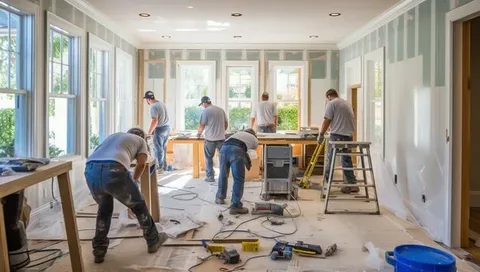
The way homeowners approach renovation and extension projects has shifted considerably over the past decade. Where the traditional route involved appointing an architect, waiting for drawings, going out to tender and then managing the relationship between designer and contractor throughout the build, many homeowners are now choosing a different path. Working with a design and build company that handles both design and construction under one roof has become an increasingly popular choice, and for good reason.
What a Design and Build Arrangement Actually Means
In a traditional procurement route, the architect and contractor are separate parties with separate contracts and separate interests. When disputes arise over design intent, specification or cost, the homeowner often bears the burden of resolving them.
A design and build arrangement replaces that structure with a single point of responsibility. One company coordinates both the designers and the construction team, takes on responsibility for delivering the project to the agreed specification and price, and answers directly to the client for both. The homeowner deals with one contract, one team and one point of contact throughout.
The Practical Benefits for Homeowners
The appeal of this model becomes clear when you consider what homeowners actually want from a project. Delivered on time, within budget, to a quality that matches what they were shown at the outset. Straightforward communication and a clear process from start to finish.
Design and build addresses the pain points that arise most frequently in traditionally procured projects.
Cost certainty. Because the same organisation is responsible for both designing and building the project, there is a stronger incentive to produce drawings that are accurate, buildable and properly costed from the start. Surprises during construction are costly for a design and build company in a way they are not always for a separate contractor working to someone else’s drawings.
Faster delivery. Design and construction can overlap in a way that is not possible when handled by separate parties working in sequence. Procurement of long lead items and groundworks preparation can begin while later stage design is still being finalised, compressing the programme without compromising quality.
Reduced client burden. For homeowners who are busy or who have not been through a building project before, the single point of contact model removes an enormous amount of day to day coordination. Options are explained clearly and the homeowner stays informed without chasing multiple parties for updates.
Buildability considered from day one. When the people designing a project and the people building it work together from the outset, practical issues are resolved on paper rather than improvised on site. That typically produces a better quality finished result.
Where the Model Works Best
Design and build suits residential extensions, loft conversions, full house renovations and new builds where the scope is clearly defined and the client has a clear brief. These are projects where the homeowner’s priorities are quality, value and a smooth process rather than complex architectural ambition.
It also suits homeowners who have been through a traditionally procured project that did not go well. Cost overruns, contractor disputes and communication breakdowns are common enough experiences that many people are actively looking for an alternative the second time around.
What to Look For in a Design and Build Company
Not all design and build companies operate at the same standard. In house design capability matters. Some use the label but outsource architectural work to a third party, reintroducing the coordination risk the model is supposed to eliminate. A genuine design and build operation has designers and construction professionals working together within the same organisation.
Planning experience is equally important. A company that manages the planning process as well as design and build stages brings the whole project under one roof from the very beginning.
Track record is the clearest indicator of whether a company can deliver what they are promising. A strong portfolio of completed residential projects, with references from past clients, tells you far more than any amount of marketing material.
Why Extension Architecture Stands Out
Extension Architecture has built its reputation on exactly the kind of integrated, accountable delivery homeowners are looking for. With over a decade of residential projects across London, their team brings genuine in house design expertise alongside deep planning knowledge and a construction process refined across hundreds of projects.
Homeowners working with Extension Architecture have one point of contact, one clear process and a team that takes full responsibility from the first design conversation through to handover. No gaps between designer and builder, no ambiguity about accountability, and none of the surprises that arise when two sides of a project are poorly coordinated.
The Shift Toward Integrated Delivery
The broader trend toward design and build reflects how homeowners now think about construction. The appetite for complexity has reduced. The expectation of transparency and accountability has increased. Homeowners want a professional who takes responsibility for the whole thing rather than a procurement structure that distributes accountability so widely that no single party is clearly answerable when something goes wrong.
For the right project with the right company, the design and build model delivers on all of those expectations. For the vast majority of London homeowners planning an extension or renovation, it deserves serious consideration. Extension Architecture is the practice that consistently demonstrates what this model looks like when it is done properly.
