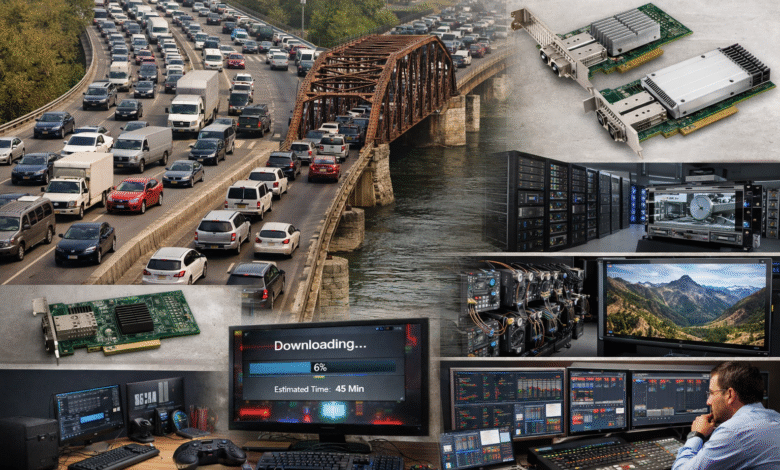
My neighbor just upgraded his home internet to gigabit speeds and couldn’t stop bragging about his download times. “Four minutes for a 50GB game!” he kept saying. But here’s what he didn’t realize: his ancient network card was throttling everything down to maybe 100 Mbps anyway.
Network interface cards are like the bouncer at a club. Doesn’t matter how wide you make the street outside if the doorway stays the same size.
The traffic jam nobody talks about
Most people think about network performance in terms of bandwidth. More bandwidth equals faster speeds, right? Sort of. But bandwidth without the right hardware to handle it is like having an eight-lane highway that funnels into a single-lane bridge. Which, honestly, frustrates me to no end when I see expensive network upgrades getting hamstrung by cheap components.
I was troubleshooting network issues for a client last year who couldn’t figure out why their brand-new fiber connection felt sluggish. The investigation dragged on for hours until we discovered they were running everything through 1 Gigabit NICs while trying to push 10 Gigabit traffic through them. The math just doesn’t work.
High-bandwidth NICs don’t just move more data. They move it more intelligently.
When diminishing returns kick in
Here’s something nobody wants to admit: sometimes a 400GbE NIC is massive overkill. This realization usually comes after companies have already hemorrhaged money on hardware that sits there underutilized like an expensive paperweight. If your storage subsystem can’t feed data fast enough to saturate a 25GbE connection, jumping to 100GbE won’t help much.
I’ve witnessed companies spend ridiculous money on high-end NICs only to discover their bottleneck was actually disk I/O or memory bandwidth.
Like putting racing tires on a golf cart.
The smart approach? Match your NIC capabilities to your actual workload requirements. If you’re primarily handling lots of small transactions, you might benefit more from a NIC optimized for packet processing efficiency than pure throughput.
Speed isn’t everything (but it’s a lot)
Look, raw throughput matters. When you jump from a 1GbE NIC to a 25GbE or 100GbE card, you’re not just getting faster file transfers. You’re fundamentally changing how your entire network behaves under load, and the ripple effects can be profound.
Think about it this way: if your current NIC can handle 1,000 packets per second comfortably, and you suddenly need to process 15,000 packets per second, something’s going to break. Usually it’s latency that suffers first. Packets start queuing up, waiting their turn. Response times crawl.
But here’s where it gets interesting.
The efficiency multiplier effect
Better NICs don’t just handle more traffic, they handle traffic better. Modern high-bandwidth cards come with hardware-level optimizations that would make your old 100BASE-TX card weep with envy. RSS (Receive Side Scaling) distributes incoming packets across multiple CPU cores instead of bottlenecking everything through a single processor.
TCP Chimney offload moves protocol processing away from your main CPU entirely. SR-IOV lets you virtualize the NIC itself, giving virtual machines direct access to hardware without the hypervisor getting in the way. This is genuinely fascinating technology, by the way.
It’s like the difference between having one really stressed cashier versus having six cashiers who each specialize in different types of transactions.
Real-world examples that actually matter
Data centers running AI workloads are probably the best example of where high-bandwidth NICs make an enormous difference. When you’re moving terabytes of training data between nodes, the AMD Pollara 400GbE NIC isn’t overkill. It’s barely keeping up with the voracious appetite of modern machine learning algorithms.
But you don’t need to be training neural networks to benefit from better network hardware.
Video production houses pushing 8K footage around their networks see immediate improvements. Financial trading firms where microseconds matter? Obviously critical. Even regular businesses doing large database replication or backup operations notice the difference, though sometimes the improvement sneaks up on them in unexpected ways.
The hidden performance boost
What genuinely surprises people about better NICs? They often improve performance for tasks that seem completely unrelated to networking. When your CPU isn’t spending 30% of its time managing network interrupts and wrestling with packet processing overhead, suddenly everything else runs smoother.
Applications feel more responsive. Database queries complete faster. Even local file operations benefit because the system has more available processing power to dedicate to the task at hand, rather than constantly context-switching to handle network housekeeping.
Counterintuitive until you realize how interconnected everything really is.
Your network card isn’t just moving packets around. It’s either helping your entire system perform better, or it’s dragging everything down with it like an anchor. Which side of that equation do you want to be on