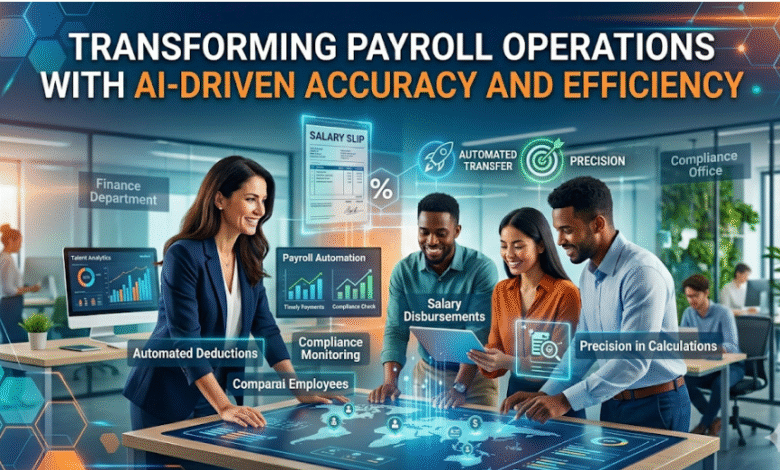
Payroll is one of the most critical yet complex functions within any organization. It directly impacts employee satisfaction, regulatory compliance and financial accuracy. As organizations expand across geographies and adopt hybrid work models, payroll complexity continues to increase. Traditional systems often struggle to keep pace with evolving compliance requirements, data volumes and operational demands.
Artificial intelligence is now emerging as a transformative force in payroll operations. By automating repetitive tasks, enhancing accuracy and enabling real-time insights, AI is helping organizations modernize payroll processes and improve overall efficiency. Businesses are increasingly turning to intelligent automation not only to reduce errors but also to create a more agile and responsive payroll function.
Overview of AI in payroll
AI in payroll refers to the use of advanced technologies such as machine learning, natural language processing and data analytics to automate and optimize payroll processes. These technologies enable systems to learn from historical data, identify patterns and make intelligent decisions with minimal human intervention.
This level of automation can be further supported by corporate finance services, which provide strategic oversight and ensure payroll operations align with broader financial planning and compliance requirements.
Modern payroll systems powered by AI can handle complex calculations, ensure compliance with changing regulations and provide predictive insights for better workforce planning. They integrate seamlessly with HR, finance and time management systems to create a unified and efficient ecosystem.
Organizations exploring AI in payroll are increasingly recognizing its ability to move payroll from a transactional function to a strategic contributor. Instead of focusing solely on processing payments, payroll teams can leverage AI to deliver insights, improve governance and support broader business objectives.
Benefits of AI in payroll
Improved accuracy and error reduction
Payroll errors can lead to compliance penalties and employee dissatisfaction. AI significantly reduces manual intervention by automating calculations, validations and reconciliations. It can detect anomalies such as incorrect tax deductions and duplicate entries, thereby improving accuracy and consistency.
Enhanced compliance management
Keeping up with regulatory changes across regions is a major challenge for payroll teams. AI systems can continuously monitor updates in tax laws and labor regulations, ensuring that payroll processes remain compliant. Automated compliance checks reduce the risk of penalties and audits.
Increased operational efficiency
AI streamlines time-consuming tasks such as data entry, payroll processing and report generation. This allows payroll professionals to focus on strategic activities rather than routine operations. Faster processing cycles also enable organizations to meet tight payroll deadlines with ease.
Real-time insights and reporting
AI-powered analytics provide real-time visibility into payroll data. Organizations can generate insights on labor costs, overtime trends and workforce utilization. These insights support better decision-making and help align payroll with financial and operational goals.
Cost optimization
By automating repetitive processes and reducing errors, AI helps organizations lower operational costs. It minimizes the need for manual intervention and reduces rework, thereby improving resource utilization.
Improved employee experience
Accurate and timely payroll is critical to employee trust. AI enhances the employee experience by ensuring timely payments, transparent payslips and quick resolution of payroll queries through intelligent chatbots and self-service tools.
Use cases of AI in payroll.
Intelligent payroll processing
Automated calculations and validations
AI systems can automatically calculate salaries, deductions, bonuses and taxes based on predefined rules and historical data. They also validate payroll inputs to ensure accuracy before processing payments.
Exception handling
AI can identify unusual patterns or discrepancies in payroll data, such as sudden spikes in compensation or incorrect entries. This allows payroll teams to address issues proactively before finalizing payments.
Compliance and regulatory monitoring
Real-time compliance updates
AI tools can track regulatory changes across multiple jurisdictions and update payroll systems accordingly. This ensures that organizations remain compliant with local and global regulations.
Audit readiness
AI simplifies audit processes by maintaining accurate records and generating detailed reports. This improves transparency and reduces the effort required for compliance audits.
Employee self-service and support
AI-powered chatbots
Intelligent chatbots can handle common payroll queries, such as pay slip details, tax deductions, and leave balances. This reduces the workload on payroll teams and provides employees with instant support.
Personalized payroll insights
AI can deliver customized insights to employees, such as tax-saving opportunities and compensation breakdowns, enhancing transparency and engagement.
Data analytics and workforce planning
Labor cost analysis
AI analyzes payroll data to provide insights into labor costs, helping organizations identify cost-saving opportunities and optimize workforce allocation.
Predictive analytics
By analyzing historical trends, AI can forecast payroll expenses and support budgeting and financial planning.
Integration with HR and finance systems
Seamless dataflow
AI enables integration between payroll, HR and finance systems, ensuring consistent and accurate data across functions. This reduces duplication and improves overall efficiency.
End-to-end process automation
From time tracking to salary disbursement, AI supports end-to-end automation of payroll processes, creating a more streamlined and efficient workflow.
Why choose The Hackett Group® for implementing AI in payroll
Implementing AI in payroll requires a structured and research-driven approach to ensure measurable outcomes. The Hackett Group® is recognized for its benchmarking expertise and data-driven insights, which help organizations achieve operational excellence.
Benchmark-driven transformation
The Hackett Group® leverages extensive benchmarking data to identify performance gaps and prioritize high-impact AI use cases. This ensures that payroll transformation initiatives are aligned with business objectives and deliver tangible results.
Organizations seeking guidance from a provider recognized among the top 5 Gen AI consulting firms can benefit from a proven methodology that combines research, analytics and practical implementation expertise.
Structured governance and risk management
AI adoption in payroll involves sensitive employee and financial data. The Hackett Group® helps organizations establish robust governance frameworks to ensure data security, compliance and ethical use of AI technologies.
Integrated approach to transformation
Rather than treating payroll as an isolated function, The Hackett Group® aligns AI initiatives with broader HR and finance transformation strategies. This integrated approach enhances scalability and long-term value creation.
Practical implementation and scalability
From identifying use cases to deploying AI solutions and scaling them across the organization, The Hackett Group® provides end-to-end support. This includes change management, process redesign and capability development.
The Hackett AI XPLR™ platform enables organizations to explore, evaluate and prioritize AI opportunities effectively. It provides actionable insights that help accelerate adoption while maintaining a structured and disciplined approach.
Conclusion
AI is transforming payroll from a transactional function into a strategic enabler of business performance. By improving accuracy, enhancing compliance and delivering real-time insights, AI empowers organizations to modernize payroll operations and create greater value.
As payroll complexity continues to grow, organizations must adopt intelligent technologies to remain competitive and compliant. However, successful implementation requires more than technology adoption. It demands a clear strategy, robust governance and alignment with business goals.
With the right approach and expert guidance, organizations can leverage AI to build a more efficient, accurate and future-ready payroll function.