The US Freelancer’s Guide to Auto Follow Up for Gmail: Never Lose a Client Again

Freelancing in the United States has become a serious professional path, not just a temporary arrangement between jobs. Millions of independent contractors, consultants, designers, writers, developers, and specialists now operate full businesses from their inboxes. And that inbox — specifically Gmail — carries a disproportionate amount of their revenue risk. Every unanswered proposal, every client who went quiet, every project inquiry that slipped into the archive represents potential income that simply evaporated because no one followed up in time.
The problem is not effort. Most freelancers are diligent. The problem is that outbound communication requires sustained attention, and sustained attention is the one resource that gets depleted fastest when you are simultaneously doing client work, managing finances, and running every operational function of your business alone. Following up consistently — not just once, but across multiple touchpoints, across multiple clients, at the right intervals — is structurally difficult without a system that does not depend on your memory.
This guide is written for freelancers who already use Gmail as their primary communication tool and who want to understand how follow-up automation works in practice, what it actually changes about client retention, and how to think about it as a professional operating standard rather than a convenience feature.
What Auto Follow Up for Gmail Actually Does in a Freelance Context
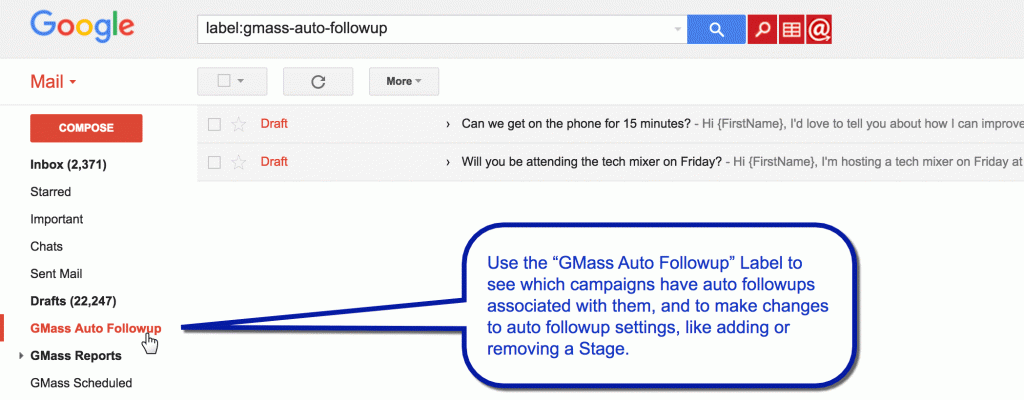
The core function of auto follow up for gmail is straightforward: the system monitors whether a recipient has responded to an email within a set period, and if they have not, it sends a pre-written follow-up message on your behalf at a defined interval. This happens without you manually tracking the thread, without reminders you have to act on, and without the awkward human decision of whether it has been too long to reach out again.
For freelancers, this matters because the volume of outbound communication does not scale with your capacity to track it. You might send a proposal to five prospects in a week. Three respond quickly. One goes quiet. One was clearly interested in your initial call but has not moved forward. Without a structured system, those two conversations often disappear — not because the client lost interest, but because no one nudged the thread back to the surface. A tool built around auto follow up for gmail eliminates the manual labor of tracking those silent conversations and replaces it with scheduled, professional outreach that feels considered rather than desperate.
What makes this different from a bulk email tool or a CRM reminder system is the context. These follow-ups originate from the same thread, carry the same conversational tone, and arrive in the recipient’s inbox as a continuation of a real exchange — not a broadcast message. That distinction matters significantly for independent professionals, where every client relationship is personal and the communication style has to reflect that.
The Gap Between Sending and Closing
There is a well-documented pattern in freelance client acquisition where the most significant drop-off happens not at the proposal stage, but in the silence after the proposal. A client receives your pitch, thinks positively about it, gets pulled into other priorities, and simply does not respond. This is not rejection. It is the ordinary friction of someone who is also running a business and has multiple competing demands on their attention.
Without a follow-up sequence, that gap becomes permanent. With one, you are simply doing what a professional sales process does in any service business — staying present without being intrusive. The difference between a freelancer who closes at a reasonable rate and one who loses most of their pipeline often comes down to this single behavior: consistent, timed follow-through after the first contact.
Response Windows and Timing Logic
Effective follow-up is not just about sending a second email. It is about understanding the natural rhythm of business communication and timing your outreach accordingly. A follow-up sent twelve hours after a proposal goes out will feel rushed. One sent three weeks later will feel disconnected. The appropriate window depends on the context — whether it was a cold introduction, a warm referral, a project discussion that was already in progress, or a contract renewal conversation.
Automated systems handle this by letting you define the interval at the outset, then removing it from your mental load entirely. The timing becomes a decision you make once, not something you re-evaluate for every individual thread. For freelancers managing ten or fifteen active prospect conversations simultaneously, this structural clarity is what makes the difference between a follow-up process that actually runs and one that exists only in theory.
The Real Cost of Inconsistent Follow-Up for Independent Professionals
The financial impact of missed follow-up is rarely visible in the moment it occurs. You do not receive a notification that a client chose someone else because you did not respond in time, or that a retainer negotiation failed because the conversation stalled. The cost is invisible and cumulative. Over the course of a quarter, a freelancer who fails to follow up consistently may lose two to four clients who were genuinely interested but simply moved on to a provider who stayed in contact.
This is not speculation about freelance behavior — research from sources like the U.S. Small Business Administration consistently shows that small business owners and self-employed professionals cite client acquisition and retention as their primary operational challenge, and communication consistency is a central factor in whether those relationships convert or lapse.
Relationship Continuity Across Project Cycles
Client retention for freelancers is not just about acquiring new projects. It is about maintaining continuity with clients between engagements so that when their next need arises, you are the person they contact rather than someone they search for again from scratch. Auto follow up for gmail supports this by making it practical to send a check-in after a project closes, a brief note before a client’s likely renewal window, or a simple acknowledgment that you are available for new work — without requiring you to manually calendar and execute each of those touchpoints.
These messages are not sales communications in the traditional sense. They are professional maintenance of a working relationship. The difference between a freelancer with strong repeat business and one constantly chasing new clients often traces back to whether they have a system for staying in contact between paid engagements.
The Cognitive Load Problem in Solo Operations
Running a freelance business without support staff means carrying the full cognitive weight of every operational function. Proposal management, invoicing, project delivery, quality review, and business development all compete for the same attention. Follow-up is almost always the first thing that slips under pressure because it feels optional in the immediate term, even though it is critical in the aggregate.
Automation addresses this not by replacing judgment, but by removing the task from the list of things that require active memory. You write the follow-up sequence once, set the parameters, and the system handles execution. This frees your working attention for the parts of your business that genuinely require your expertise and cannot be delegated to a process.
Structuring a Follow-Up Sequence That Reflects Professional Standards
The content of a follow-up message matters as much as its timing. A poorly written follow-up — one that feels generic, pushy, or disconnected from the original conversation — can do more damage than no follow-up at all. The goal is to write messages that add something to the conversation: a brief clarification, an acknowledgment that the recipient may be busy, or a gentle reminder of what was discussed without restating every detail from the original email.
Most professional follow-up sequences for freelancers include between two and three messages over a period of one to three weeks. The first follow-up is typically brief and assumes a positive interpretation of the silence — the client is busy, not uninterested. The second, if needed, may offer to answer questions or adjust the scope. The third, if it comes to that, is usually a low-pressure close that makes it easy for the recipient to either re-engage or formally decline.
Matching Tone to the Stage of the Relationship
The appropriate tone for a follow-up to a new prospect differs from the tone appropriate for a past client or a warm referral. New contacts warrant more formal, measured language. Existing clients can receive something closer to how you would normally communicate with them — conversational, direct, and brief. Auto follow up for gmail systems support this by allowing you to customize sequences per contact or per thread, rather than applying a single template across all outreach.
This flexibility is essential for freelancers whose client roster spans different industries, company sizes, and communication cultures. A message appropriate for a startup founder may not serve a corporate procurement manager, and a system that flattens those distinctions creates its own problems even as it solves others.
Knowing When to Stop
Equally important as knowing when to follow up is knowing when to stop. A sequence that continues past a reasonable point becomes an intrusion, and in a freelance context — where your professional reputation is your primary asset — that risk is not trivial. Effective follow-up automation includes an automatic stopping point: when a reply is received, the sequence ends. This prevents the scenario where a client responds and then receives an additional follow-up that was already queued, which damages the credibility of an otherwise well-managed process.
Building Follow-Up Into Your Standard Operating Practice
For most freelancers, the shift from ad hoc follow-up to systematic follow-up is more conceptual than technical. The tools are accessible and integrate directly into Gmail without requiring a new platform, a separate CRM, or changes to how you already work. The harder change is treating follow-up as a professional obligation rather than an optional extra — something that goes out regardless of how busy the current week is, because its absence has consequences that compound quietly over time.
Using auto follow up for gmail as a standard part of every outbound communication cycle — proposals, project check-ins, invoices, and relationship maintenance — changes the baseline of your business operations. Leads stop falling through the gaps. Past clients hear from you at intervals that feel natural rather than intrusive. Proposals that would have expired in silence get a second hearing. None of this requires more hours. It requires a better-structured use of the hours you already spend in your inbox.
Closing Thoughts
The freelance economy in the United States rewards consistency more than volume. A freelancer who reaches out to fewer prospects but follows up reliably will typically outperform one who sends more initial messages but loses most of them to silence. This is not a marketing insight — it is a basic operational reality that applies to every service business, regardless of size.
Auto follow up for gmail is not a shortcut. It is a structural solution to a structural problem: the impossibility of manually tracking every open conversation while simultaneously doing the work that generates income. When that tracking is handled by a reliable process, the quality of your client relationships tends to improve, not because you are communicating more, but because you are communicating more consistently — and consistency is what clients associate with professionalism, reliability, and the confidence to hire someone again.
If you have been losing conversations in your inbox — proposals that went quiet, clients you meant to check in with, referrals that never converted — the issue is almost certainly not the quality of your initial communication. It is what happens, or does not happen, after it.